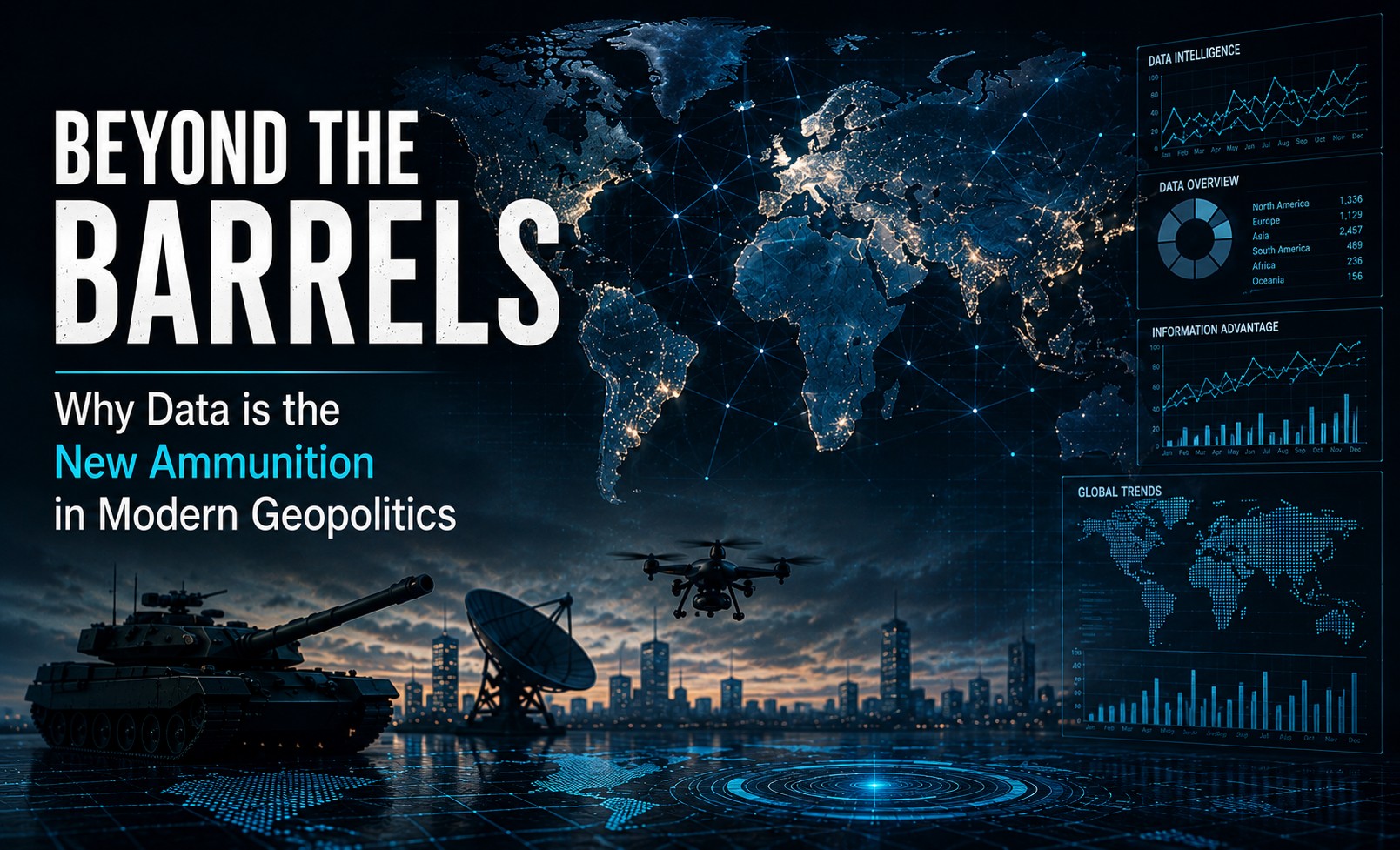
Beyond the Barrels: Why Data is the New Ammunition in Modern Geopolitics
Usman Ali
When British mathematician Clive Humby coined the phrase “data is the new oil” in 2006, it perfectly captured the emerging reality of the digital age. Raw information, much like crude petroleum, possessed immense latent value that could only be unlocked through systematic extraction and refinement. However, recent geopolitical escalations in the Middle East have demonstrated that this metaphor is no longer sufficient. We have crossed a critical threshold where data has transcended its role as merely an economic resource. Today, data is not just the new oil; it is the new ammunition.
The Architecture of Digital Vulnerability
Historically, global power was determined by control over physical assets—oil reserves, steel production, and strategic maritime chokepoints such as the Strait of Hormuz. In the 21st century, however, the architecture of power has shifted toward compute: the advanced semiconductors, hyperscale data centers, cloud infrastructure, and undersea communication cables that sustain artificial intelligence and the modern digital economy.
Unlike oil, which depends on centralized geographic capture points, computational power is distributed across interconnected digital systems. Yet this decentralized architecture has simultaneously introduced unprecedented vulnerabilities. The boundaries between civilian and military infrastructure are rapidly dissolving, drawing multinational technology corporations and cloud platforms into the frontlines of asymmetric conflict. When adversaries target regional data centers or communication infrastructure, it becomes clear that the foundations of the digital economy are now viewed as strategic military assets.
AI and the Speed of War
The true destructive potential of this new form of ammunition is unlocked through Artificial Intelligence. Data processing power is no longer a passive auxiliary tool operating in the background; it is now actively integrated into modern chains of command. AI-enabled intelligence fusion systems can compress decision-making cycles from days into mere seconds by synthesizing satellite imagery, drone surveillance, intercepted communications, and predictive analytics to automate targeting processes.
At the same time, cyberspace has emerged as the primary theater for asymmetric warfare. State-sponsored cyberattacks deploying sophisticated wiper malware against financial institutions, energy grids, and communication systems demonstrate how weaponized data can paralyze a society’s economy and logistical infrastructure without a single conventional shot being fired. The rapid proliferation of AI-generated misinformation further obscures objective reality, proving that controlling the narrative has become just as strategically important as controlling the battlefield itself.
The Crisis of Algorithmic Sovereignty
This transformation has introduced a profound geopolitical challenge: the evolution from data sovereignty to algorithmic sovereignty. It is no longer sufficient for nations to merely accumulate data; they must also control the systems, computational models, and logical frameworks that interpret and operationalize it.
The increasing dependence on AI-driven targeting algorithms has simultaneously sparked a severe ethical crisis. Automation bias—the tendency of human operators to defer unquestioningly to machine intelligence during high-pressure scenarios—can result in catastrophic failures in judgment and target validation. We are learning, often through devastating consequences, that flawed intelligence executed at AI-enabled speed becomes a weapon of mass disruption.
Forging a Responsible Digital Future
Navigating this volatile new era requires far more than securing semiconductor supply chains or strengthening cyber defenses; it demands ethical foresight and interdisciplinary thinking. As students and professionals entering the rapidly evolving fields of computer science, artificial intelligence, and cybersecurity, we stand at the intersection of technological innovation and global security.
Institutions such as Beaconhouse National University play a vital role in shaping this future. By fostering an interdisciplinary educational environment that combines rigorous technical training with strong foundations in liberal arts, ethics, critical inquiry, and social responsibility, universities can prepare the next generation of innovators to navigate the complexities of the digital age responsibly.
The challenge before us is not simply to build more powerful systems, but to ensure that the immense computational power defining this century is governed with wisdom, accountability, and humanity. Only then can this new form of “ammunition” be redirected away from global instability and toward sustainable, equitable human progress.