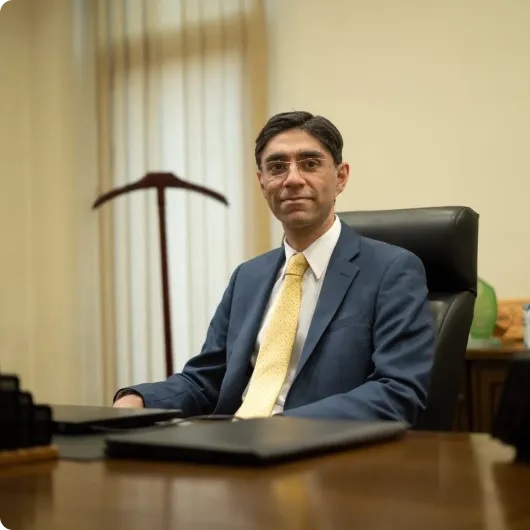
Dr. Moeed W. Yusuf slass - BNU

Dr. Moeed W. Yusuf

Academician & Foreign Policy Strategist

Vice Chancellor

Seeta Majeed School of Liberal Arts and Social Sciences

Dr. Moeed W. Yusuf is Vice Chancellor of Beaconhouse National University and a Senior Fellow at Harvard’s Belfer Center. Previously Pakistan’s National Security Adviser and Associate Vice President at USIP, he spearheaded Pakistan’s first National Security Policy. An acclaimed author, he advises globally on foreign policy and South Asian strategic affairs.

Bio

Dr. Moeed W. Yusuf is a globally recognized scholar, foreign policy strategist, and academic leader serving as the Vice Chancellor (President) of Beaconhouse National University (BNU), Pakistan’s first purpose-built liberal arts university. He also holds an appointment as a Senior Fellow at the Belfer Center for Science and International Affairs at Harvard University’s Kennedy School of Government, where his research focuses on the strategic choices of middle powers navigating the evolving global order.

Prior to assuming leadership at BNU, Dr. Yusuf served in the Government of Pakistan as the National Security Adviser (NSA) to the Prime Minister (2021–2022) with the status of a Federal Minister, having previously served as Special Assistant to the Prime Minister on National Security Division and Strategic Policy Planning. In these roles, he served as the principal adviser on the National Security Committee, spearheaded the drafting and codification of Pakistan’s first-ever citizen-centric National Security Policy, established the Islamabad Security Dialogue, and reformed top state-affiliated think tanks, including the Islamabad Policy Research Institute (IPRI).

Dr. Yusuf's extensive international career includes over a decade in senior leadership roles at the United States Institute of Peace (USIP) in Washington, D.C., where he served as Associate Vice President of the Asia Center. He has held academic, research, and advisory affiliations with Boston University, Harvard University, the Brookings Institution, the World Bank, and the United Nations Development Programme (UNDP). A prolific author, he has published several books with leading academic presses, including Brokering Peace in Nuclear Environments: U.S. Crisis Management in South Asia (Stanford University Press), and regularly contributes strategic analysis to Foreign Affairs and major international media.

Academics

  • PhD in Political Science – Boston University, Boston, MA, USA 
    • Functional Concentrations: International Relations & Comparative Politics | Regional Specialization: South Asia.
    • Dissertation: “Brokered Bargaining: Nuclear Crises between Middle Powers” (Focus on third-party crisis behavior, U.S. mediation, and nuclear stability).
    • Nominated for the CGS/ProQuest Distinguished Dissertation Award as BU's top social science dissertation.
  • M.A. in International Relations – Boston University, Boston, MA, USA 
    • Thesis: “Pakistan’s Nuclear Policy: Where is it Headed?”
  • Bachelor of Business Administration (BBA) – Shorter College, Rome, GA, USA
    • Major: Management | Thesis: “The Road to September 11, 2001 and Beyond.”

Leadership Experience

Academic & University Leadership
  • Vice Chancellor (President), Beaconhouse National University (BNU), Lahore, Pakistan (Jun 2023–Present)
    • Directs strategic, academic, administrative, and institutional growth for Pakistan's premier liberal arts institution.
    • Pioneered campus-wide policy frameworks, research growth, and international institutional partnerships.
  • Senior Fellow, Belfer Center for Science and International Affairs, Harvard Kennedy School, USA (Mar 2024–Present)
    • Directs research initiatives on Middle Power strategies, regional security architectures, and international order.
  • Visiting Faculty / Fellow Positions:
    • Lahore University of Management Sciences (LUMS) – Conflict Resolution (2019, 2022).
    • Elliott School of International Affairs, George Washington University – Graduate Peacebuilding (Summer 2018).
    • Pardee School of Global Studies & Department of Political Science, Boston University (2007–2018).
    • Mossavar-Rahmani Center for Business and Government, Harvard Kennedy School (2008–2009).
    • Quaid-i-Azam University, Islamabad – Defense Economics (2006).
State & Public Policy Leadership
  • National Security Adviser to the Prime Minister, Government of Pakistan (May 2021–Apr 2022)
    • Principal adviser on the National Security Committee (NSC); led national security dialogues with global counterpart NSAs.
    • Conceived, authored, and implemented Pakistan’s first citizen-centric National Security Policy.
  • Special Assistant to the PM on National Security Division & Strategic Policy Planning (Dec 2019–May 2021)
    • Led whole-of-government strategic policy planning and coordinated cross-departmental priority tasks.
  • Chairman, Strategic Policy Planning Cell (SPPC), National Security Division (Oct 2019–Dec 2019)
    • Established the state’s primary intellectual hub for evidence-based policy inputs and expert council models.
Global Think Tank Leadership
  • Associate Vice President (Asia Center), United States Institute of Peace (USIP), Washington, D.C. (May 2016–Sep 2019)
    • Executive manager of USIP’s largest department covering East, Southeast, South, and Central Asia.
  • Director, South Asia Programs, USIP, Washington, D.C. (Oct 2013–May 2016)
    • Established USIP’s country office in Pakistan and directed peacebuilding, rule of law, and governance portfolios.
  • Senior Pakistan Expert & South Asia Advisor, USIP, Washington, D.C. (2010–2013)
  • Fellow, Frederick S. Pardee Center for the Study of the Longer Range Future, Boston University (2008–2009)

Board Positions and Advisory Roles

Institutional & Academic Boards
  • Chairperson, Committee on Curbing Drug and Tobacco Abuse, Higher Education Commission (HEC), Pakistan (2026–Present)
  • Member, Board of Governors, Punjab Higher Education Commission (PHEC) (2025–Present)
  • Member, Board of Governors, HITEC University, Taxila (2026–Present)
  • Member, Board of Governors & BNU Foundation Board of Directors, Beaconhouse National University (2023–Present)
  • Chairperson, Advisory Board, Google Career Kamyabi Program (2024–Present)
  • Member, Steering Committee, The Pakistan Initiative, USA (2025–Present)
  • Member, Leadership Council, Sustainable Development Solutions Network (SDSN), Pakistan (2025–Present)
  • Member, Senate (Board), National Defence University (NDU), Pakistan (2021–2024)
  • Patron-in-Chief & Board Member, Islamabad Policy Research Institute (IPRI) (2020–2024)
  • Council & Executive Committee Member, Pugwash Conferences on Science and World Affairs (Nobel Peace Prize 1995) (2013–2019; 2023–Present)
International Corporate & Technical Consulting
  • Advisory Committee Member, Digital Ocean (San Francisco, CA) – Strategic advice on IT expansion and geoeconomics (2023–Present)
  • Strategic & Technical Adviser for UNDP Pakistan, The World Bank, and UK FCDO on regional trade connectivity, Afghanistan economic recovery, and youth policy (2017–2025)
  • Senior Strategic Adviser, The University of Lahore & Tabadlab Advisory Services (2022–2023)

Publications

Authored & Edited Books
  1. Yusuf, M., Kahoot, S. N., & Qazi, A. S. (2026). From Risk to Resilience: BNU Substance Use Control Program (A Guide to Creating a Drug-Free University Campus in Pakistan). Beaconhouse National University Press.
  2. Yusuf, M. (2018). Brokering Peace in Nuclear Environments: U.S. Crisis Management in South Asia. Stanford University Press.
  3. Yusuf, M. (Ed.). (2014). Pakistan’s Counterterrorism Challenge. Georgetown University Press.
  4. Yusuf, M. (Ed.). (2014). Insurgencies and Counter-insurgencies in South Asia: Through a Peacebuilding Lens. United States Institute of Peace Press.
  5. Najam, A., & Yusuf, M. (Eds.). (2013). South Asia 2060: Envisioning Regional Futures. Anthem Press.
  6. Smith, S., Yusuf, M., & Cookman, C. (Eds.). (2013). Getting it Right in Afghanistan. United States Institute of Peace Press.
Journal & Magazine Publications
  1. Yusuf, M. (2025). Why America Should Bet on Pakistan. Foreign Affairs (September 11, 2025).
  2. Yusuf, M. (2025). Brokered Bargaining in Nuclear South Asia: U.S. Mediation in the India-Pakistan Pahalgam Crisis. Arms Control Today, 55 (July/August 2025).
  3. Yusuf, M. (2025). Has the U.S. Prevented Another India-Pakistan War? Belfer Center for Science and International Affairs, Harvard Kennedy School (May 2025).
  4. Yusuf, M. (2021). How Pakistan Sees Afghanistan: Peace is Possible Only if the World Engages With the Taliban. Foreign Affairs (October 2021).
  5. Yusuf, M. (2019). The Pulwama Crisis: Flirting with War in a Nuclear Environment. Arms Control Today, 49 (May 2019).
  6. Yusuf, M. (2017). A Marriage Estranged: The Strategic Disconnect between Pakistan and the United States. Asia Policy, 24 (July 2017).
  7. Yusuf, M., & Kirk, J. (2016). Keeping an Eye on South Asian Skies: America’s Pivotal Deterrence in Nuclearized India-Pakistan Crises. Contemporary Security Policy, 37(2).
  8. Yusuf, M. (2011). Getting Pakistan to Act Against Militant Sanctuaries: Helping Pakistan to Help Itself. Journal of International Peace Operations, 7(4).
  9. Yusuf, M. (2011). Banking on an Outsider: Implications for Escalation Control in South Asia. Arms Control Today, 41 (June 2011).
  10. Yusuf, M., & Najam, A. (2009). Kashmir: Ripe for Resolution? Third World Quarterly, 30(8).
  11. Yusuf, M. (2009). Forest Management in Pakistan: A Legal and Institutional Analysis. McGill International Journal of Sustainable Development Law and Policy, 5(1).
  12. Yusuf, M. (2009). Rational Institutional Design, Perverse Incentives, and the US-Pakistan Relationship post-9/11. Defense Against Terrorism Review, 2(1).
  13. Yusuf, M., & Hussain, N. (2009). Pacifying Conflict through Economic Interdependence: Prospects in the Case of Jammu and Kashmir. IPRI Journal, 9(1).
  14. Yusuf, M., & Hussain, N. (2008). Traditional versus Human Security: The Case of Missing Persons in Pakistan. South Asia Journal, 22.
  15. Yusuf, M. (2007). The Indo-US Nuclear Deal: An Impact Analysis. ISYP Journal on Science and World Affairs, 3(2).
  16. Yusuf, M. (2007). Using Trade as a Driver of Peace: Prospects in the Indo-Pak Context. Criterion, 2(3).
  17. Yusuf, M. (2004). The U.S. and the Islamic Radicals: Conflict Unending? International Social Science Review, 79(1–2).
  18. Yusuf, M. (2003). World’s Most Likely Nuclear Flashpoint: South Asia or the Korean Peninsula? The Recorder, 46(3).
Academic & Policy Papers (Book Chapters)
  1. Yusuf, M. (2013). Pakistan’s View of Security in the Indian Ocean. In J. Garofano & A. J. Dew (Eds.), Deep Currents and Rising Tides: The Indian Ocean and International Security. Georgetown University Press.
  2. Yusuf, M. (2013). The Intersection of Development, Politics, and Security. In A. Weiss & S. G. Khattak (Eds.), Development Challenges Confronting Pakistan. Kumarian Press.
  3. Yusuf, M. (2011). Youth and the Future. In S. P. Cohen et al. (Eds.), The Future of Pakistan. The Brookings Institution.
  4. Yusuf, M. (2011). Pakistan-U.S. Relations: An Inconvenient Partnership of Convenience. In A. Misra & M. Clarke (Eds.), Pakistan’s Stability Paradox. Routledge.
  5. Yusuf, M. (2011). A Society on the Precipice? Examining the Prospects of Youth Radicalization in Pakistan. In M. Kugelman & R. M. Hathaway (Eds.), Reaping the Dividend: Overcoming Pakistan’s Demographic Challenges. Woodrow Wilson Press.
  6. Khan, S., & Yusuf, M. (2011). Education as a Strategic Imperative. In M. Lodhi (Ed.), Pakistan: Beyond ‘The Crisis State’. C. Hurst & Co.
  7. Yusuf, M., & Banuri, K. (2010). India’s Quest for Ballistic Missile Defense: A Slippery Slope. In S. Ghoshroy & G. Neuneck (Eds.), South Asia at a Crossroads: Conflict or Cooperation in the Age of Nuclear Weapons, Missile Defense, and Space Rivalries. Nomos.
  8. Khan, S. R., Yusuf, M., Shaheen, F. H., & Tanveer, A. (2008). Regional Trade Agreements in South Asia: Trade and Conflict Linkages. In S. R. Khan (Ed.), Regional Trade Integration and Conflict Resolution: Southern Perspectives. Routledge.
  9. Khan, S. R., Shaheen, F. H., & Yusuf, M. (2008). Managing Conflict through Trade: The Case of Pakistan and India. In S. R. Khan (Ed.), Regional Trade Integration and Conflict Resolution: Southern Perspectives. Routledge.
  10. Khan, S. R., Yusuf, M., Bokhari, S., & Aziz, S. (2007). Quantifying Informal Trade Between Pakistan and India. In Z. F. Naqvi & P. Schuler (Eds.), The Challenges and Potential of Pakistan-India Trade. The World Bank.
Policy Papers (Research Institutes & Think Tanks)
  • Yusuf, M. (2026). In the Eye of the Storm: Pakistan’s Balancing Act in the Evolving Geopolitical Order. Middle Powers Project, Harvard Kennedy School.
  • Yusuf, M., & Haider, E. (2026). Is a Stable Middle Power Order Possible?: Europe’s Role in an Alternative Future. Policy Paper, Friedrich Ebert Stiftung.
  • Yusuf, M. (2026). Lessons from the “Champions of the 21st Century”. Friedrich Ebert Stiftung Pakistan.
  • Yusuf, M. (2026). Future Pathways in the Middle East Conflict: How the War Could End or Escalate. Policy Beacon (Vol. 36), BNU Center for Policy Research.
  • Yusuf, M., & Zeb, R. (2026). A Quarter Century of Nuclear South Asia: Nuclear Noise, Signalling, and the Risk of Escalation in India-Pakistan Crises. Carnegie Endowment for International Peace and Nautilus Institute.
  • Yusuf, M. (2025). Going Against the Grain: Implementing Pakistan’s Geoeconomic Pivot Amidst Geopolitical Chaos. Friedrich Ebert Stiftung Pakistan.
  • Yusuf, M., & Akhter, R. (2023). Pakistan’s Geoeconomic Pivot: Strategies, Opportunities, and Challenges. Friedrich Ebert Stiftung Pakistan.
  • Yusuf, M. (2018). Conflict in Afghanistan: Behind the Pak-US Disconnect. In Between War and Peace: Afghanistan Essays. Jinnah Institute.
  • Yusuf, M. (2015). Afghanistan-Pakistan Relations: The Prospect of Reviving Taliban Talks. Peace Brief, United States Institute of Peace.
  • Yusuf, M., & Smith, S. (2015). Ashraf Ghani’s Pakistan Outreach: Fighting against Odds. Special Report, United States Institute of Peace.
  • Yusuf, M. (2013). Decoding Pakistan’s ‘Strategic Shift’ in Afghanistan. Stockholm International Peace Research Institute (SIPRI).
  • Yusuf, M. (2012). Fixing Pakistan’s Civil-Military Imbalance: A Dangerous Temptation. Peace Brief, United States Institute of Peace.
  • Yusuf, M., Yusuf, H., & Zaidi, S. (2011). Pakistan, the United States, and the End Game in Afghanistan: Perceptions of Pakistan’s Foreign Policy Elite. Jinnah Institute and U.S. Institute of Peace.
  • Yusuf, M. (2011). Stability in the Nuclear Context: Making South Asians Safe. Security Brief, Jinnah Institute.
  • Gopalaswamy, B., & Yusuf, M. (2010). Nuclear South Asia: Implications of the Indian and Pakistani Arsenals. Program in Arms Control, Disarmament, and International Security (ACDIS), University of Illinois.
  • Yusuf, M. (2010). Correcting America’s Image Problem in Pakistan. Peace Brief, United States Institute of Peace.
  • Yusuf, M. (2010). Community Targeting for Poverty Reduction: Lessons from Developing Countries. Pardee Papers No. 8, Frederick S. Pardee Center for the Study of the Longer Range Future, Boston University.
  • Yusuf, M. (2009). Promoting Cross-LoC Trade: A Study of the Joint Chamber. Special Report, United States Institute of Peace.
  • Yusuf, M. (2008). Predicting Proliferation: History of the Future of Nuclear Weapons. Brookings Institution.
  • Yusuf, M. (2008). Does Nuclear Energy have a Future? Pardee Papers No. 3, Frederick S. Pardee Center for the Study of the Longer Range Future, Boston University.
  • Yusuf, M. (2008). Prospects of Youth Radicalization in Pakistan: Implications for U.S. Policy. Brookings Institution.
  • Yusuf, M. (2007). Poverty Reduction Initiatives in Pakistan: Search for an Optimal Targeting Strategy. Asian Development Bank.
  • Yusuf, M., & Mukherjee, A. (2007). Counterinsurgency in Pakistan: Lessons from India. National Security Outlook, American Enterprise Institute.
  • Yusuf, M. (2007). Exploring the Potential for Economic Development and Cross-LoC Collaboration in Jammu Kashmir. Pugwash Issue Brief, Vol. 5, No. 1.
  • Brown, O., Shaheen, F., Khan, S. R., & Yusuf, M. (2005). Regional Trade Agreements: Promoting Conflict or Building Peace? Working Paper, International Institute for Sustainable Development.

Contact

  • Official Email: vc@bnu.edu.pk
© 2026 BNU.
Powered bytossdown.com