
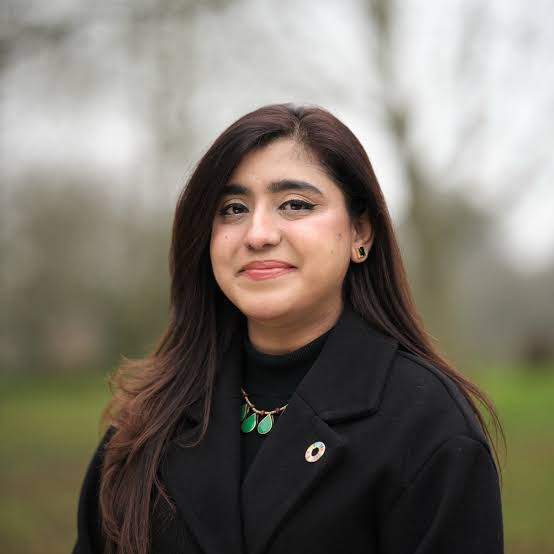
Aruj has worked in educational leadership, teaching and curriculum planning since 2013, including in the IB Diploma Programme at Beaconhouse College Campus and as the head of an academic department. At BNU's School of Education, where she completed her MPhil in Educational Leadership and Management in 2022, her research explored how International Baccalaureate practitioners in Pakistan could embed Whole School Approaches to Sustainability. Under the guidance of Dr. Qudsia Kalsoom and Dr. Naima, that work produced Khaliq's Spiral Framework and Becoming Sustainability Pedagogues, described as Asia's first teacher development toolkit for Education for Sustainable Development.
In 2023, Aruj was the only Pakistani invited by University College London to present at UNESCO Headquarters in Paris, where she introduced the first Global South–driven theoretical framework on Whole School Approaches to Sustainability. That same year, she joined the United Nations Sustainable Development Goals Conference at Kinnaird College for Women University as a field expert and panel speaker. Through ALIF (Academic Leaders' Innovation Forum), the enterprise she founded, her dissertation became ECO Schools, Pakistan's largest school-based sustainability intervention, funded by Interloop with UCL as knowledge partner. She is also the creator of IB Ripple, the world's first research journal for IB students.
Her ambition then took her to the University of Oxford, where she completed an MSc in Evidence-Based Social Intervention and Policy Evaluation (2024–2025) as the inaugural recipient of the Spirit of Hong Kong Scholarship. Specialising in social interventions and policy on eco-pedagogy and artificial intelligence, she served as Academic Representative for Lady Margaret Hall and conducted the first global qualitative evidence synthesis on teacher agency in AI-infused classrooms, drawing on data from 18 countries. Her concept of "The Thinking Machine Paradox" examines what happens to human judgement when classrooms share decisions with AI. Today she brings that research into policy as an Executive Advisor to Pakistan's National Artificial Intelligence Task Force, and has served as Head of Academics at Learning Alliance International. A 30 Under 30–nominated educational leader, she was a featured speaker at OEB Global 2025 and continues to give back to her alma mater as visiting faculty at BNU's School of Education.
Her advice to future researchers
Aruj encourages students to start with their "why" and pursue real gaps rather than fashionable ones. Research and social impact can be lonely, she says, so protect your well-being, ask for help when you need it, and above all stay persistent, because support tends to arrive for those who keep going.